ERMSS – Energy Risk Management and Security of Supply
by Eric Patrick Ford, NORCE
As energy systems grow more interconnected, ensuring a stable and secure supply is becoming more challenging. To address this, researchers at NORCE have created a new planning tool under ELEXIA, the ERMSS – Energy Risk Management and Security of Supply, which helps test how different parts of an energy system respond to failures, disruptions, and changes in demand.
Building the System Model
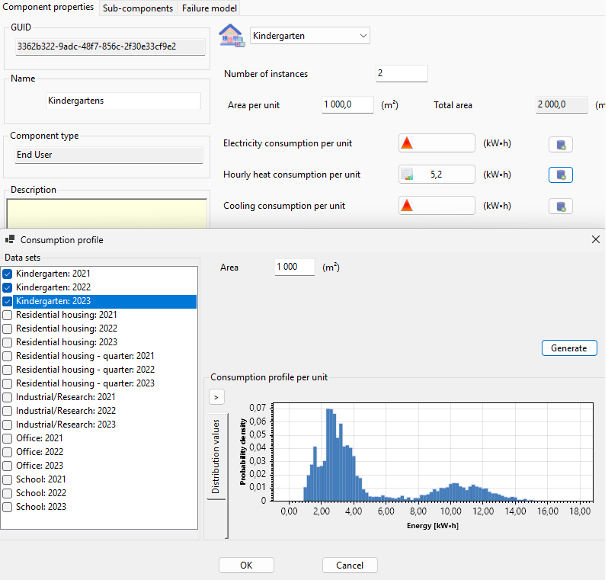
Fig 2. Defining energy consumption profiles for end users based on predefined data sets
ERMSS allows users to build and test models of connected energy systems — including energy sources, converters, grids, storage units, and end users. Each component can be customized with its own capacity, reliability, and demand values. Through stochastic (randomized) simulations, the tool estimates how well the system can meet energy demand under different scenarios such as equipment failures or maintenance interruptions.
The tool features a user-friendly graphical interface that lets users easily create and connect system components (see Fig. 1). Users can assign probability distributions to key parameters, such as supply capacity or energy use, based on historical data or estimated ranges (Fig. 2). This makes it possible to include uncertainty and variability in the model results.
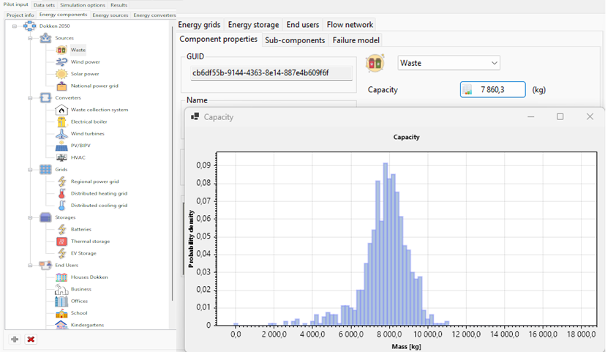
Fig 1. Graphical user interface of ERMSS, showing some defined types of energy components (left) and a probability distribution based on historical data for yearly amount of collected waste, used as a basis for waste capacity of the energy system (right).
System Structure and Modelling
Each energy component includes general properties like capacity, number of units, and expected lifetime. Users can also build detailed sub-models, adding sub-components to represent more complex system structures. Energy demand for end users can be defined from statistical data or by scaling existing datasets to match the size of the consumer group being modeled.
Failures and maintenance events are included through a Weibull-based lifetime model, which defines how likely a component is to fail over time. Failures are classified as:
Critical, where all instances of a component fail completely.
Degraded, where only part of the component capacity is lost.
Faulty output, where the component continues to operate but with reduced performance.
Planned maintenance events can also be added to simulate temporary reductions in capacity.
The links between components define energy flows — specifying direction, capacity, and conversion efficiency. Once the network is built, the user can configure Monte Carlo simulations, running thousands of randomized cases that include variations in demand, supply, and system conditions.
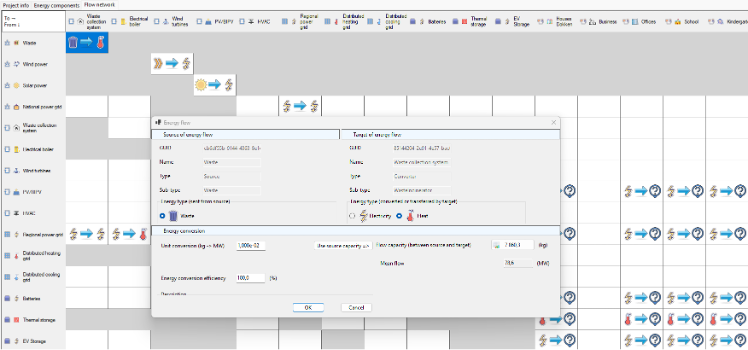
Fig 3. The energy system and associated flow network is established by linking together connected components. The table is structured by rows of origin of energy flow (from) and columns of destination of energy flow (to), where each cell is specified by properties of flow between origin and destination.
Simulations Results
The simulator automatically creates a flow network model, representing energy sources, nodes, and consumers. Results are presented through visual dashboards and graphs showing how well the system performs across all simulated scenarios.
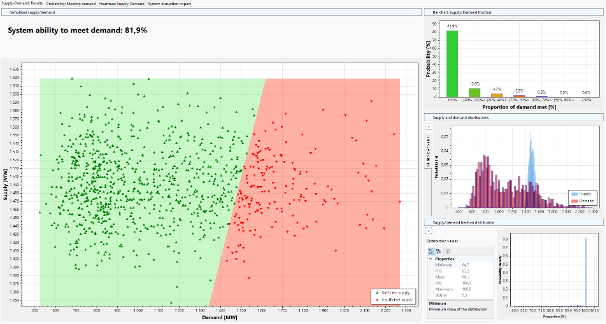
Simulated system ability to supply requested energy demand. Main window (left) shows all simulations as points in XY-space where x is demand and y is supply, green region represents cases where supply > demand, red region where supply < demand. Upper right shows bar plot of distribution for various supply-demand cases. Middle right shows the range of supply and demand as probability distributions (blue is supply, red is demand). Lower right shows probability distribution for supply/demand fraction.
Why ERMSS Matters
Because modern energy systems are deeply interconnected, a small failure can ripple across the entire network. ERMSS provides a practical way to test those risks before they occur in real life. By highlighting weak points, critical components, and the effects of maintenance, the tool helps energy planners and decision-makers strengthen supply reliability.
By offering both flexibility and a clear user interface, the tool provides valuable guidance for energy planners, utility companies, and policymakers. As energy demand continues to rise and renewable sources are integrated into the grid, tools like ERMSS will be essential for ensuring reliable, secure, and resilient energy supply in the future.